Monday, June 24, 2019

PubMed Was a Mistake

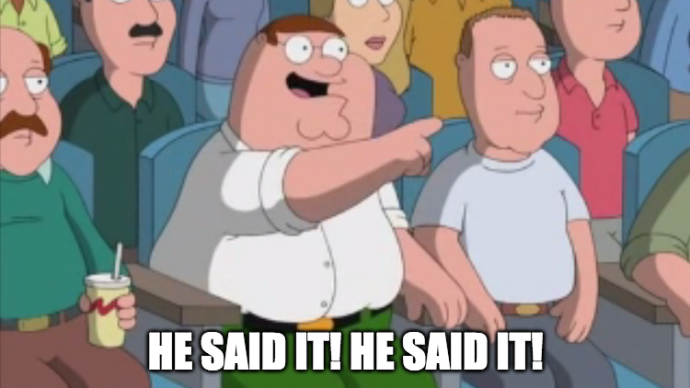
The idea of PubMed is a wonderful one that is a great service to humanity. But as the saying goes, no plan survives engagement with the enemy. In this case, the enemy is also humanity. Specifically, the humanity that finds itself on internet forums getting into arguments with each other in a proxy battle for the dominance they are unable to feel in real life because their spines and genitals are too small. In this realm of everyone trying to be the smartest idiot for sale in the Idiot Store, this theoretically excellent resource is reduced instead to:

Pictured: The fantasy of an asshole.
PubMed links, instead of being useful pieces of a puzzle that an educated individual can piece together to form a whole in the course of conducting research in a field, have become like Pokemon cards. Your opponent played Rectal Expulsion Volume Reaching Input Device Contact in Uneducated Subjects, Graham et al, 1992? What a goddamn sucker, you had A Meta-Analysis on Prevalence of Oral-Rectal Reversal in Youths, Cunningham and Ortiz, 2001 in your back pocket, just waiting to be slammed down into the comment box. Score - You: 1, Sucker: 0. Should've known that Graham types are weak against Cunningham types. Build your PokePub deck more carefully next time, idiot.

The internet has had a relatively extreme reaction to "bro-science" and "muscle mags" - training information that is "cutting the ends of the ham" or "get people to buy things" in terms of its level of quality. In rebellion, those who consider themselves intelligent have created the new cult of "evidence based training". In theory, training advice based on evidence is an excellent thing that I support wholeheartedly. This is not an "anti-science" rant. It is an anti-layperson and anti-punching-above-your-weight rant. It is important to keep trainees apprised of bad sources of information - those who don't know anything and are misguided, or predators who outright lie in order to make sales. It is important to acquire and share good information that has been tried and tested and has some evidence of being effective.

But the difference between theory and practice is that in theory there is no difference, and again the problem is the intellectual laziness of human beings. "Evidence Based" is a term that should cover a broad spectrum of information sources, but much of the time it's simply used as a fluff term for arguments like:
  • Citation needed - aka, link to PubMed or you're wrong and fuck you
  • I'll just leave this here - aka, here's a link to PubMed so I'm right and fuck you
  • <50 PubMed links> - aka, I just scored 50 points in this argument, how many links you got? 
A coach with a several decade track record of results in their trainees is operating based on evidence. That dude who got big and strong in your gym doing their own thing is operating based on evidence. These people may have read zero science. They may have never even questioned "why" the things they do work, and just have discovered methods that work through trial and error. This is also valid evidence. But to many novices who have spent most of their lives considering themselves intellectuals, what once was worth considering is now "bro-science" because it did not use an abstract as a road map.

A modest proposal - PubMed should be DNS black-holed outside of educational institutions or should at least be kept behind a requirement to show that your brains aren't made entirely of crayons and Elmer's glue.

I feel that the following statements are broadly true, with non-zero but minimal exceptions.

If you:
  • Are not reasonably well educated in a field
  • Have not been exposed to or engaged directly in the actual process of scientific research
  • Have not read the full text of the study
  • Cannot explain what the strengths, weaknesses, and limitations of the study are
  • Cannot explain what the strengths, weaknesses, and limitations of research in this field are
  • Have not read a significant amount of similar research
You should probably not:
  • Be on PubMed (or any similar other site) at all
  • Be linking anyone to PubMed (or any other similar site) at all
  • Be talking about scientific studies without massive caveat of being a total layman
  • Be using any study as a trump card in any argument
Because you:
  • Probably lack the knowledge and experience necessary to properly parse and evaluate what you're reading
  • Probably aren't capable of forming a useful opinion based on scientific study
  • Probably aren't actually interested in science as a concept or in furthering it as a method in the search for better information
And your goal is not to be "evidence based" if:
  • You treat studies like Pokemon cards that you can mic drop on people who argue with you
  • You ignore that scientific study is imperfect and cannot answer all questions or test all possibilities
  • You treat studies as the only possible source of truth and ignore empirical evidence
  • You ignore that some things are simply going to be unknowable, especially in advance
In summary: There's a reason scientific research and analysis thereof is done by those with high level education and not you or me.

(Somebody's going to accuse me of gatekeeping.)

The Sign on the Gate that Says "Keep Out"

Like a lot of words and phrases, the word "gatekeeping" started off as an occasionally useful term that, when applied in an appropriate context, described a very specific kind of behavior in a negative way. Then somebody used it appropriately on Reddit to great effect, got a lot of visibility, and the bottom feeders of the internet suddenly learned a new word that they could treat like the argument equivalent of this:

Pictured: The inside of an internet idiot's head
And, like so many others before it, the internet diluted the meaning of "gatekeeping" to, roughly, "any time somebody says somebody I like (especially me) isn't welcome somewhere".

"Gatekeeping" has a very specific qualifier in its - usually due to undue resentment or overprotectiveness - because the point of the term is to point out a case where placing a limitation on someone else's participation in something is broadly unreasonable. It is not a catch-all term for putting a minimum qualification on being able to participate in an activity or conversation.

If people in real life used the term "gatekeeping" the way people use it on the internet, you would hear things like:
  • What do you mean I can't tell you how to repair your car? That I've never actually worked on a car shouldn't matter - I've read all the manuals and I've got a YouTube video right here on my phone. That's gatekeeping.
  • What do you mean I'm not qualified to tell you whether or not your leg is broken? I may not have been to medical school, but I know a broken leg when I see one. That's gatekeeping.
  • What do you mean I can't be on the football team? I may not have ever played football in my life, but I've watched every NFL game since I was a kid. That's gatekeeping.
  • What do you mean you won't hire me as a nuclear power plant engineer? My dad was the janitor at a nuclear plant for 30 years and he told me all about it. I'm more than qualified. That's gatekeeping.
Nobody says these things in real life. 

Because they're stupid. 

But tell a guy who has been lifting for a month, or years but isn't strong, that his opinions on strength training aren't interesting and he should listen instead of talk, and you'll hear every possible variation of why you're being a gatekeeper and why the messenger shouldn't matter because it's about the information, man.

I'm here to tell you - No.

The messenger always matters, and sometimes the how of "mattering" is that who they are and what they've done doesn't matter enough.

If you found yourself with a terrible disease, and lamented it to a drunken stranger in the bar, and they told you:
My man, let me tell you what. You don't have to die. I had it my man, I had it bad. And you know what I did? My pappy he was in the War, the big one. He was a chemist, see - helped make the mustard gas. And he figured out that he could refine the gas a bit, break it down a bit, you know, dose me up with some needles, and that'd fix me right up. Gave me a bunch of sores, made me real weak, and I shit myself a lot, but it got me all fixed up good. Look into it man. Give it a try. You won't regret it.
Would you listen to that person? Of course not.

But what if your doctor told you that one of the best drugs for your cancer was the alkylating agent, nitrogen mustard, and that while it had some bad side effects your chances looked pretty good?

Same information. Different messenger.

"tHaT'S A RiDiCuLoUs aNd eXtReMe eXaMpLe aNd iS A StRaW MaN"

Every distinction of some people having authority on a topic and others not in the world is "gatekeeping" if you go by the definition that's used on the internet.

I believe, strongly, that it is important for every person to have an honest understanding of when they matter and when they don't. This is not simply when giving advice, but in going through life. Some people cry "gatekeeping" when they are told that they and what they have to say don't matter. But your schooling lied to you - The ability to regurgitate blurbs of information does not make you matter. In most cases, what you have done yourself is a reflection of how useful the knowledge you have is. This is the application to yourself or to others as a coach, teacher, or mentor. With only rare exceptions, you are a billboard for the quality of what you know.

There are times when it is not appropriate to speak, but to simply listen. I have compared r/weightroom's goal with regards to novices to that of a campfire - The grizzled veterans of war or the hunt sharing their tales and experiences with each other, while those who are green sit quietly, listen, and sometimes ask questions provided they're thoughtful. It's important not simply to understand when you are the veteran and when you are the youth, but to be willing to accept that you may have nothing useful to contribute to a conversation in the first place. And, realizing and accepting that, not talking just so that you can feel that you participated.

But to the internet, telling people that their opinions on how to accomplish something don't automatically deserve to be heard just because they have opinions is "gatekeeping".

Setting aside the incorrect usage of the term to begin with, in almost all cases I've witnessed "gatekeeping" is not even the pejorative that some try to use it as. A hard to swallow pill is that experienced people generally aren't interested in the opinions of the inexperienced. Professionals do not go to conferences to have conversations about their field with laymen - they go to have conversations with other professionals. The experienced trainee is no different. It is not an insult to tell someone experienced "You just don't want to hear from people who aren't as experienced as you, meanie!!". Uhh, yeah. Damn right they don't. Thanks?

Bottom line of this rant - Remove the word "gatekeeping" from your vocabulary, because it will almost always make you sound like a wank. It is definitely not going to get anyone to start listening to or caring about you who already was not. If you want to be listened to and cared about, provide value - be someone of value, who is interesting, who has done something, who has something useful to share.

Monday, June 3, 2019

A Purely Hypothetical Business Model

What I'm about to describe is totally not something that someone is already doing with great success. There is not someone who is doing this right now and raking in a ton of money in the process. Definitely not.

I want to plant a little seed. Put the following questions at the back of your mind and let them ruminate a bit.

  • Why would somebody sell training equipment equivalent to a $40 loadable dumbbell handle and ~$70 worth of weight plates, for $800?
  • Why would somebody sell a training plan that you can only access for a few months for $80, and unlimited access to the same training plan for $100?
-

Before you get too excited about all the money you're going to make, know that this business plan isn't for everybody. There's a key component that makes it work that is non-negotiable - you need both academic and empirical credentials. You'll want to have at least a Masters degree in something relevant to fitness (physiotherapy is a really good one), as well as having worked with a person or group of people who are important, such as a high level athlete or sports team. It doesn't matter for how long or how successfully - you just need to factually be able to say that you've done it. This is very important and the plan collapses without it. Your baseline credibility must be (effectively, if not actually) unassailable.

In any business plan, you need to have a target demographic. Yours has the following characteristics:
  • Male
  • Consider themselves to have above average intelligence
  • Consider themselves to be scientific or evidence based minded
  • Have lived a generally sedentary life or are generally unfamiliar with physical activity and exertion, possibly due to an injury in the past
  • Generally have modest physical fitness goals
  • Generally have an aversion to high levels of exertion and physical development
  • Have probably tried to work out in the past and not got the results they wanted, and generally believe it was because of something they didn't know rather than something they didn't do
  • Has a broad, general fear of injury and doing things wrong
The second and third points are why the credentials are non-negotiable - half of the work of selling yourself as someone to trust will be done by your targets, on their own, just by knowing that you have those credentials to stand on. Think of Dr. Oz - The guy is demonstrably a raging quack and yet people still trust him because they trust "Dr.". The last point is why physiotherapy is a great candidate for an academic credential - it will help reassure them that you have the knowledge to keep them safe and takes down some of the barriers to selling themselves on you.

Now, for the execution.

The primary goal of this business plan is to create a rapport and trust relationship between you and your followers. You want your followers to consider your credibility as unassailable, and your information sacrosanct. You will be able to leverage that relationship to empty their wallets.

To start, you'll need to be producing YouTube videos regularly. YouTube is important for the following benefits:
  • It feels more like a personal interaction to have someone talking to you, visually.
  • It allows you to present information in dynamic and interesting ways, such as demonstrating exercises, being generally charismatic, making dramatic examples, or drawing on whiteboards.
  • It gives you a reasonable excuse to have your own physical development on display at nearly all times.
  • It occupies time in your followers' lives and therefore more of their headspace.
  • Likes and subscription numbers are effectively free marketing.
  • It can generate extra income in the form of ad revenue, though this is a very distant last in terms of importance.
Here are some guidelines for producing the kinds of videos that you'll need to meet your primary goal. Many of these are variations on the theme of Sharing Secret Knowledge. You are letting your followers in to the Inner Circle, where the Secrets that they failed by not knowing will be brought out of the darkness for them to use with great success. This is the feeling that you will be looking to inspire in your followers, but should never say outright. Your target demo considers itself too smart to fall for "One Weird Trick" (even though that's exactly what they want and is exactly what you'll give them), so make sure that's not how you come off.
  • "The Best Exercises For <Body Part>" - These are a goldmine of content. There are many muscles in the body, many ways to work them, and many variations on those exercises. Because your target demo is generally unfamiliar with exercise, you can get away with presenting exercises that are staples to the experienced but uncommon enough that they will be novel. You can reuse this general idea for the same muscle group by presenting it in different ways. You can do "these are the best", "you're probably not doing these", "here's some fun ones" and so on.
  • "STOP DOING <EXERCISE>" - You want to make sure to play on your followers' fears of injuring themselves or doing something that isn't optimal, so pick some common exercises and make videos about why they're actually harmful or not good and shouldn't be done, or should only be done with certain modifications. These types of videos will be especially useful to you if your academic credential is physiotherapy related.
  • "YOU'RE DOING <EXERCISE> WRONG" - A variant on the above, these are your bread and butter "One Weird Trick But Totally Not A One Weird Trick" videos.
  • "THE TRUTH ABOUT <TOPIC>" - Or other "mythconceptions" themed videos. You can stretch these really far simply by constructing a strawman that borders on unrealistic and attacking it. These will be the main opportunity for you to demonstrate that you are "No Nonsense" to your followers - that you are there to dispel the ridiculous myths that plague the fitness industry for them.
  • In general, you should strive to fill your videos with as much information as possible. Simple anatomical and biological information is a great candidate for this. Use established but uncommonly known terms for things frequently but not overwhelmingly. Remember - Your target demographic considers itself to be above average intelligence and will eat up content that makes them feel smart. You want to be feeding them information that they feel they can show off when talking to others, or use as talking points if they get into an argument. They will often completely overlook the fact that this information has very little actionable, practical value to it because they feel smarter by knowing it.
Now, what is this all for? I said earlier that you will be able to leverage the relationship you create with your followers to empty their wallets. Let's put it all together.

Obviously, you need to have products to sell. These should be extremely high profit-margin items as much as possible. Branded supplements, training routines, and diet programs are top tier here. Supplements are dirt cheap to create and can be marked up substantially. Training routines and diet programs can effectively be created once and sold to (tens of) thousands of people at enormous profit for minimal work. You can also delve into training equipment, marked up with the value of your name.

Many of your followers will not purchase your products, and that is by design. Those that don't pay you directly serve as living, breathing advertisements to bring in others who will, and they will do it because you made them feel like you gave them everything they need for free. That is why the rapport and trust relationship is so important. Your goal is not simply to create or reel in customers - it is to create an army of free, "organic" advertising for your products. Word of mouth is incredibly powerful. When your followers are on fitness forums singing your praises, they drive more potential advertisers and customers towards you. And the whole time, they will be thanking you, not realizing that manipulating them into what they're doing is the real reason you did it. Every piece of content you've produced has been for the sole purpose of tricking people into selling themselves on either paying exorbitant prices for what you're selling, or being free advertising for you to find others that will.

The other way that you drive sales is through the good will factor. This is similar to how free-to-play games with microtransactions make some of their sales. Your followers will convince themselves that they owe you support (money) because of all the information (remember that last point from the YouTube section?) you've given them for free, out of the goodness of your heart. They might say things like "He told me all about this routine on his channel, but I bought it for the convenience and to support him". And then they will open their wallets and dump them into your bank account.

-

That was a bit of a long walk, wasn't it?

Do you remember what I asked you to ruminate on at the beginning?

  • Why would somebody sell training equipment equivalent to a $40 loadable dumbbell handle and ~$70 worth of weight plates, for $800?
  • Why would somebody sell a training plan that you can only access for a few months for $80, and unlimited access to the same training plan for $100?
You probably thought when you first read those questions that the answer was something like "Because they're a scumbag trying to rip people off". It is, but it's also not. The real answer is - Because they're a scumbag who knows how to manipulate people into being thankful that they were ripped off.

This is totally hypothetical, though. Totally.

Thursday, May 23, 2019

Crystal Balls Do Not Exist


When I was in college, I had a professor with a background in play acting who liked to tell us:
If you want to make it to the high levels in this industry, you can't just show up every day. You have to show up.  Every day.
In his mind, there was a difference between showing up and showing up. Showing up is just walking through the door and existing in your office, punching the time card. Showing up is actually being there, putting on the best show you've got in you - as in, showing up the competition.

Put a pin in that.

A long time ago I watched a show (which Google tells me is called Sports Night), and there was a line in an episode that stuck with me because of what my professor said.
Casey: Technically, I have a plan.
Dan: What's the plan?
Casey: It's Napoleon's plan.
Dan: Who's Napoleon?
Casey: A 19th century French emperor.
Dan: You crackin' wise with me now?
Casey: He had a two-part plan.
Dan: What was it?
Casey: First we show up, then we see what happens.
At the time, I thought this combination was profound and I still sort of do. Just more in a quiet, respectful nod sort of way and less in a scribbling this on my trapper-keeper sort of way.

The actual quote attributed to Napoleon, as it turns out, is even better - On s'engage, et alors on voit. "We commit ourselves, and then we see."

Fitness forums are under a constant deluge of questions like this, from people who need the Wisdom of Napoleon.
  • I made a bet with my friend that I could bench 225 before the end of the year. Can I do it?
  • How much muscle would I gain if I did AwesomeGrasshopper's PAPAUALAPALAAA routine? (The A stands for Abs)
  • How quickly can I get abs if I do Wrathlete-X's $300 Ab Massacre routine?
  • What would happen if I took Arnold's Basic Blueprint and did 5/3/1 percentages for half the lifts, GZCLP for a quarter of the lifts, Conjugate for the remaining quarter of the lifts, and then also added Brian Alsruhe's conditioning on top of it?
  • Will it be effective if I add pull ups every other day?
  • Can I look like Brad Pitt in 12 Monkeys if I fast for four days a week and do keto the other three?
There are two answers to these questions, and they are the same for every one of them. The first is "Try it and find out". The second is "Fuck you".

MythicalStrength is fond of saying that most questions about training are really just asking for permission. I think it goes beyond that - I think they want to be able to say that someone else is responsible if they fail. If they fail, they don't want it to be "I made the decision to do this, and it was not a good decision", they want it to be "I got bad advice". (That's why Answer #2 is "Fuck you".)

And the reality of all these questions is that Crystal Balls Do Not Exist.


Questions like this, which amount to asking other people to predict the future, need to be answered with Napoleon's Strategy. You need to show up, then see what happens. Commit yourself (to trying something), and then see.

You can't know in advance "what's going to work". It might be the perfect plan... for a teenager with infinitely disposable time. It might be incredibly effective... but you hate it so you never work hard enough at it. Everyone I know who is strong and been at this for a long time says the same thing - They've tried a lot of different things. Some of them worked, some of them didn't. They liked some, they hated some. Some stopped working. Some didn't start working until later on.
Anything I've ever attempted, I was always willing to fail. [...] You can't always win, but don't afraid of making decisions. [...] You can't be paralyzed by fear of failure or you will never push yourself.
- Arnold Schwarzenegger

With training, you have to be willing to commit to something without knowing in advance what's going to happen with it, really work hard at it, and find out what the results are - even if the results are "failure".

The other side of the coin here is that you actually have to show up. You can't just bleh your way through the thing. The "see what happens" part doesn't have any value if you don't try. We don't live in Waterworld where you can piss bad effort into a training plant and get delicious, muscley water out the other end. If what you put into your training is piss, you're just gonna get pissed later on.

Asking silly questions and being afraid of not getting it right the first time you try is a strategy for L7 weenies. Use the strategy of a conqueror. Show up, and see what happens.

Definitely don't think about how he ended up making a really dumb tactical decision, got his army frozen to death, and ended up imprisoned on an island though.


Tuesday, May 21, 2019

"Realistic Expectations" is a Dog Whistle, in That You Can Only Hear It if You Are a Bitch

List of situations where it matters if someone has taken steroids and not been forthcoming about it:
  1. They are participating in a competition which explicitly does not allow the use of steroids.
  2. They are using their physique to sell products, such as supplements or routines, with the claim it will make you look like they do.
End of list.

Of the things we get bitched to about on r/Fitness, the rule against slinging accusations of steroid usage at other users is around #3 in terms of frequency. Known colloquially as "The Natty Police" or "Angry Halloween Decorations", there is a cadre of young men on Reddit who, in the name of "Realistic Expectations", have taken it upon themselves to establish an unofficial Ocular Division of the World Anti-Doping Agency. Armed with knowledge of androgen receptors and FFMI, these unsung heroes soar through the skies, descending onto progress threads to save impressionable beginners from the shattering disappointment of "Unrealistic Expectations" - the stock-in-trade of Fake Naturals.

Photo: Natty Police Special Agent in the wild

At least, that's what they claim. The reality is less altruistic.

"(Un)realistic Expectations" is an appeal that comes up a lot when talking about Fake Naturals. The idea is that if you're a Fake Natural, and you share your progress with the world, people will be inspired and try to look like you and train the way you did. But they can't, because they're Real Naturals. No matter how hard they try, for how long, they will never look like you. This will make them sad, and they will be definitely, absolutely devastated and then definitely, absolutely give up.

I'm actually laughing right now.

Here's a thing I believe in very strongly - grit. Grit is a firmness of character or an indomitable spirit. To have grit is to take adversity, challenge, limitation, and failure in stride. This is not simply important for getting big and strong - it is a life skill. However, it's not an easy thing to develop or keep up with, so some people choose not to try at all. Instead of facing a hard world and deciding to become hard to match, they strive to change their world to be as soft as they are. That's a choice that everyone is allowed. I don't know why you would want to choose being fragile and weak over being resilient and strong, but you're allowed to.

But sometimes people can't make that choice in silence, own that they made it, and move on with their lives. That would be the right thing to do. They need external permission to make the choice, and external validation that it was the right choice. So they go out into the world like a Typhoid Mary, puking a bunch of sad bastard talking points trying spread their mind disease. They tell themselves that they are saving people from being hurt, but it's really just about poisoning somebody, anybody else so that they aren't alone.

There's an insipid lie inherent in caterwauling about "Unrealistic Expectations" - That not measuring up to An Impossible Standard is why this person gave up. The truth is much less forgiving - a person who gives up because someone else did the same thing better than they did has a fundamental anatomy problem. They have an Eeyore where their spine is supposed to be. They were never cut out to succeed and would have given up for a different reason. They had no grit. Successful people don't give up because somebody else is better. Successful people don't give up because they don't succeed immediately.

There's two sides of the coin that I want to distinguish here.
  • If you've already been indoctrinated into the Ocular WADA, I'm sorry to say that you're probably beyond saving, so please do the world a favor and just be honest with yourself - you are a sad sack that wants everyone else to be sad sacks with you. Stop telling yourself that you care about helping other people. You don't. It's okay to be a sad sack. People will still love you, probably. Just be a quiet one.
  • If, on the other hand, you're somebody who wants to get big and strong, and you're just starting out or still finding your way, and you run into people who talk about Unrealistic Expectations - IGNORE THEM. They are not your friend. They will only bring you down. Don't ever put a time limit on your own success and don't ever let cartoon donkeys tell you what you can or can't accomplish. Develop grit - it will be invaluable and irreplaceable. Don't be somebody who gives up on their goals so easily.
To wrap up, let's do a compare and contrast and think about which sounds more like something a successful person would say.


After I was finished with my bodybuilding career I wanted to get into acting and I wanted to be a star in films. Everyone had the same line, that it can’t be done. The rules said that actors with accents could not be leading men. I broke that rule. I didn’t care if no one in history had ever done it. I worked hard, and I became a leading man.
Anything I’ve ever attempted, I was always willing to fail. You can’t always win, but don’t afraid of making decisions. You can’t be paralyzed by fear of failure or you will never push yourself. 
How many times have you heard that you can’t do this and you can’t do that and it’s never been done before? I hear this all the time. If I had listened to these people, I would still be in Austria, up in the Alps, yodeling. When I was 15 years old and told people I wanted to be a champion bodybuilder, right away they told me it wouldn’t happen. You know something? I didn’t listen to them. I moved to America. I became a bodybuilding champion.
- Arnold Schwarzenegger

No one OHPs over 225 without steroids.
his ab size confirms it. To have abs show, the person needs low body fat, but to get abs that big cant be done naturally.
yes that dude is juicing. But he easily could not have been on roids and gotten virtually the same difference in those pictures. Hardly flexing poor lighting/angles no pump on the left and everything going for him on the right. But he almost definitely was.
big, shredded, natural - Pick two.
- Fuckin' nobodies from the internet

Copying the Smart Kid's Homework

Opinion: There is no reason for most trainees to delve into programming principles or exercise and nutritional science.

Having been on the internet for twenty years and been part of more forums and communities than I can remember, I feel comfortable saying that Reddit, more than any other, seems to be a magnet for people who want to feel like they're smart and that they're being smart. I don't know why this is. I want to emphasize my use of the word feel there, because as anyone who has had some knob try to mic drop them with the name of a logical fallacy they found in that infographic from Imgur (you know the one) can tell you, it's usually less about actually being and more about the feeling.

For some people, feeling (and having others congratulate them for being) smart is very important to them. This is not entirely their fault, but it is a poisonous mindset that will frequently take their hand with a smile and a hug and then walk them directly into a pit. When they try to get into strength training or fitness, the sign over that pit is frequently "Doing Research".

Let's be clear: It's an important thing for there to be testing and understanding about the human body and its responses to various kinds of exercise through scientific study. It's important for there to be coaches with many years of experience with training people, trying things out, seeing what works and what doesn't, and building training methods from empirical evidence. Somebody should be "doing research". But that somebody is not you. For some people, it is a smart idea to blaze forward into the weeds, ingest a ton of information, and coalesce it into some kind of methodology or action plan. For you, that idea is stupid.

To illustrate why I think you're stupid for trying to be smart, here's an imperfect analogy.

Hearken yourself back to your childhood when your parents descended from on high and bestowed your very first set of Legos. Did the box contain a textbook on architecture, physics, or mechanical engineering? Did it contain a book on the concepts of building things out of Legos? Would you have known what to do with any of that if it did? Of course not.

If instead of the boxed set, your parents had dumped all the pieces onto the floor in front of your little drooling face, what would you have built out of it? Would you create the pizzeria your hungry plastic townspeople so desperately need? No. They would starve and die.

What if they had bought you the pizzeria, a pirate hideout, a fire station, a space ship, and a castle, put all of the pieces into one of those plastic storage bins, and set it down in front of you? Would you create a pizzeria, a pirate hideout, a fire station, a space ship, and a castle? Of course not. If you were able to process the six completely different sets of Legos all smushed together enough to make anything at all, it would be an irredeemable trainwreck.

What did the box actually have in it? It had a booklet with pretty pictures that told you, step by step, how to build your pizzeria. Because, like most eight year olds, you don't know anything. But that's the wonderful thing about Legos - You can build what you want no matter what you know, because they always come with that little booklet. You can build your entire Lego Metropolis based entirely on following instructions.

This is an imperfect analogy. I don't want to hear about it from a voice that comes out of your nostrils.

The point here is that there's a pervasive fantasy on Reddit that the most intelligent way to get started with something you're inexperienced with is to do the following:

  1. Create a firehose of as many opinions, articles, studies, blogs, and videos as possible - preferably from as many sources as possible - and insert it directly into your mouth.
  2. Swallow a few thousand gallons data and ruminate on it until you shit out the Perfect Action Plan for pursuing your goal which covers every possible base down to the most minute detail.
When you say it out loud, that sounds kind of stupid. But it's what new trainees do all the time because they never stop to think about what they're doing, and they don't realize that the real Step 1 of that process is this:

  1. Completely ignore that having little to no background, knowledge, or visceral experience is a hard barrier to properly sorting, filtering, understanding, and digesting what you consume.

So I repeat: There is no reason for most trainees to delve into programming principles or exercise and nutritional science.

My experience through several years of observation has been that trying to be "smart" instead of just painting by numbers usually ends in one of two ways - getting completely lost in the weeds and overwhelmed with trying to build a Nirvana Routine out of PubMed articles and dozens of different training philosophies and not starting at all, or creating a nightmarish chimera that looks more like you used a dartboard than your brain.

What most trainees need to do is stop trying to be smart themselves and just pick any one of the hundreds of smart kids they can find and copy their homework.

Another imperfect analogy: I'm a software engineer. If every bug I fixed or feature I added was something I created entirely from scratch, I'd never deliver on time and I'd be fired. At my company, my job is to solve problems and deliver on goals - not to be innovative - and this is frequently a matter of copying how other people did the same or similar things to what I'm working on. When my company can't receive money from customers that want to give us money, there is no one at any level of management that will congratulate me for taking a day and a half to write my own solution if I could have fixed it in a few hours because I used Google to find out how other people have already solved the same problem. It's somebody's job to pioneer new technology, but it's not mine.

This is a hard thing to accept. School beats it into you over and over that using someone else's work instead of doing your own is cheating or the dreaded plagiarism. But this has done you a disservice, because in much of The Real World, repeating work that other, smarter people have already done isn't admirable - it's usually wasteful and stupid. "Reinventing the wheel" is a pejorative for a reason. The idea that you always need to DIY things is poison.

This whole thing is particularly for novices, but I really think it applies to most people in general.
You can get really, really far into your pursuit of strength training by just copying somebody else's plan and busting your ass at it. Find a reputable coach and follow their Lego instruction booklet. It doesn't even need to be something you empty your wallet for. There's free homework laying (lying? I should have copied somebody's English homework I guess) all over the place.

And ultimately, the real trap in this thought process is overestimating how much your specific plan matters - especially when you're just getting started. Strength training isn't math homework with one correct answer - it's an essay. Lots of people are saying lots of things that are different without being wrong.

Stop trying to prove that you're smart. It's OK not to think sometimes.

On Starting Strength and StrongLifts

I've had the thought rolling around in my head for a while to do what I'm about to do, which is take this page off the Wiki and put ...